
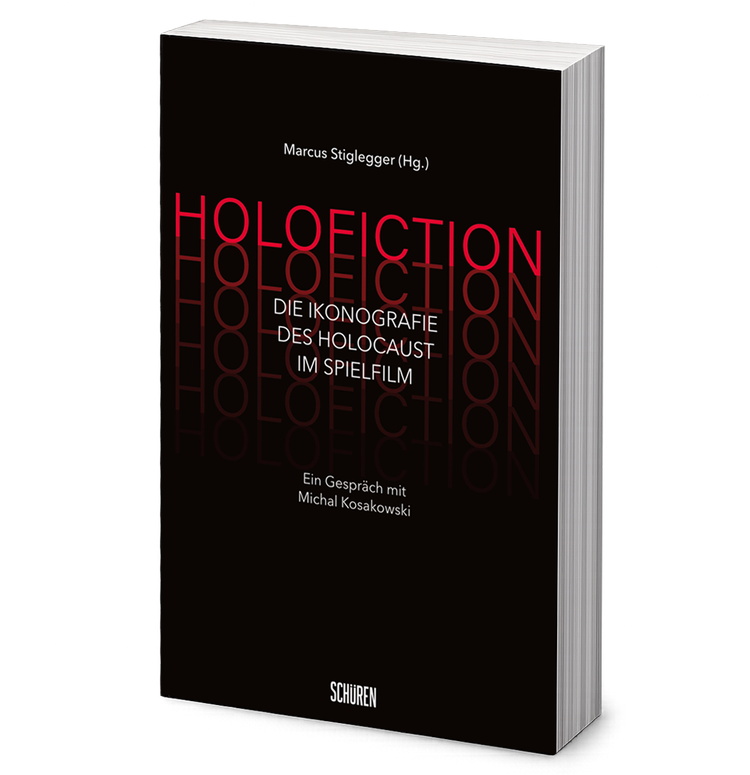
HOLOFICTION - DIE IKONOGRAFIE DES HOLOCAUST IM SPIELFILM
(The Iconography of the Holocaust in Feature Films)
Book edited by Marcus Stiglegger, 192 pages, Schüren Verlag, July 2026
Foreword by Volker Schlöndorff
How I Discovered the Images of the Shoah and What They Did to Me
Holofiction is a shock therapy and at the same time a scholarly work on the inadequacy of the human imagination. Indeed, "unimaginable" is the first and most fitting word that comes to mind in any description of this universe of horror. Not since Goya's Disasters of War has so much cruelty been depicted. Michal Kosakowski set out to systematically catalogue the images that cinema has come up with on the subject. The result is as shocking as it is sobering: it is always the same images, whether in Hollywood films or in European arthouse productions. Almost all of them can be traced back to the same documentary footage that the Allies shot when liberating the camps. As if the imagination of hundreds upon hundreds of artists who have grappled with how the horror can/may be depicted had no "images of their own" in their heads. The compilation proves how the imagination of all of us could only create "images of its own" – or rather could not create them – by starting from documentary images.
In a seemingly endless sequence, Holofiction first shows orderly assembly points, marches through peaceful towns to train stations, the brutal loading of freight trains, luggage thrown in after, doors slamming shut, frightened faces behind barred windows, departing trains, arriving trains, booted guards, vicious dogs, roll-call grounds behind barbed wire, emaciated faces, skeletons at work in quarries, smoking chimneys. On the side of the guards: gramophones playing tango, foxtrot, waltz, cuckoo clocks striking the hours, primroses in flowerpots on windowsills. Each of these images, seen individually, is harrowing; all of them together, en masse, more of the same, become ineffectual clichés. As if one had copied from the other, which is not the case, as I know from my own experience. Perhaps the proof of Claude Lanzmann's thesis that the Holocaust cannot be staged, cannot be filmed.
That was my conviction too, after I saw Alain Resnais' Nuit et brouillard / Night and Fog for the first time in 1956. It was in a small French town where I was staying as an exchange student. Of course I had heard about the camps, mainly in jokes about the use of gas and the making of glue from bones. I cannot recall any concrete description, any images or figures about the Holocaust from my lessons at school in Wiesbaden. This subject was taboo in Adenauer's Germany, in schools as in society. The Holocaust was practically denied through silence. That is why I was in no way prepared, intellectually or otherwise, for what I now saw.
Only a decade after the end of the war had Alain Resnais begun to sift through the film footage. It had disappeared in the archives. Resnais knew how difficult it was to deal with such images. If the audience is merely exposed to a shock, they cannot grasp the incomprehensible.
I don't want to overwhelm the audience, I want to unsettle them, shake them awake, make them curious, let them discover something.
Resnais travelled to Auschwitz with his cameraman Sacha Vierny. In order to have images of their own, they filmed the remains of the camps – in colour, as a contrast to the newsreel documents. They filmed the grass now growing between the tracks, the rusted barbed wire of the electric fences, the cracks in the concrete walls of the gas chambers and, above all, the shoes and glasses, piled up into veritable mountains, that had belonged to those who were murdered – and also the mountains of hair that had been cut off them to make felt blankets.
These images made possible what no power of imagination had achieved before: to imagine the death of millions. The images of the piles of corpses had overwhelmed the audience; the mountains of spectacle frames moved them. With the long tracking shots along the fence of the former camp, the director had first of all created a way in. Within this framework, the actual documents had an all the stronger effect.
The impact Night and Fog had back then is unimaginable today. Holofiction shows how, over the past 70 years, these images have been used and worn out for illustrative purposes – inflationarily, undignifiedly and indiscriminately. But when the lights came on in the cinema back then, I was certain that these events would forever elude any kind of staging.
That was 1956. Since then there has been the Holocaust television series, Sophie's Choice, Schindler's List, The Pianist, Son of Saul, Korczak and many others, so that when, 50 years later, I read the diary of a priest about his imprisonment in Dachau concentration camp, I asked myself whether we Germans should continue to place this subject under a taboo and leave it to others forever Father Jean Bernard, a Luxembourger, described what he had experienced concretely, soberly, without any pathos, with almost documentary precision. He tells it in small details, almost in close-ups, subjectively, from the point of view of the prisoner who no longer has the strength for the big picture, for wide shots, who only perceives the heels of the man in front of him or the spoon in his tin bowl. That is exactly how I then shot the film: in fragments, in close-ups.
Volker Schlöndorff, April 2026