
3 TALKS | HOLOFICTION
Essay by Michal Kosakowski
published on artechock.de (German)
October 8, 2026
(English translation)
Three Festivals, Three Conversations, Three Perspectives on the Same Images
With HOLOFICTION, I had the rare opportunity over the past few months to discuss the same film in three very different cultural and political contexts. At three international festivals –DocAviv in Tel Aviv/Israel, the Krakow Film Festival in Poland, and the Toronto Jewish Film Festival in Canada – the film became the starting point for public panel discussions. What struck me most was how profoundly the questions changed from one place to another, even though they all revolved around the very same film: HOLOFICTION
TEL AVIV: IMAGES AS THE PRESENT
The first of these discussions took place on 31 May 2026 during the DocAviv Film Festival at the Tel Aviv Cinematheque. It was titled The Attack on the Image: The Collapse of Cinematic Space.
The panel was moderated by Shira Havron and Shani Kiniso and brought together filmmaker Ronit Ifergan, filmmaker Assaf Lapid, filmmaker and film scholar Michal Lavi, and myself as the director of HOLOFICTION.
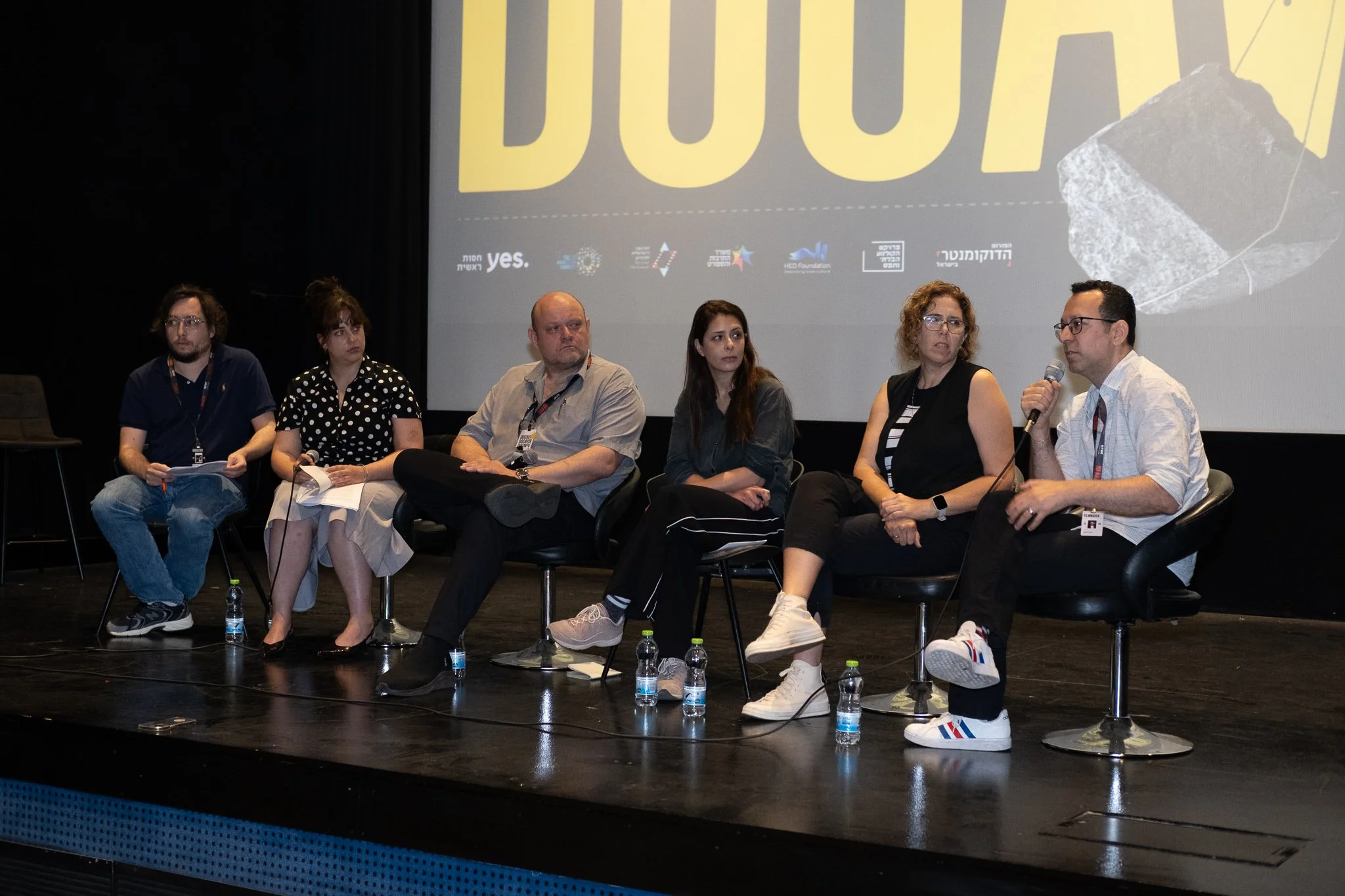
From left to right: Shani Kiniso, Shira Havron, Michal Kosakowski, Michal Lavi, Ronit Ifergan, Assaf Lapid • Photo © Eran Peretz
From the outset, the conversation differed fundamentally from many previous discussions about the film. While HOLOFICTION examines how cinema has shaped our collective imagination of the Holocaust, the discussion in Tel Aviv focused on a much more immediate reality: the Hamas attacks of 7 October 2023 and the images they produced.
I was the only non-Israeli on the panel. The people sitting beside me had lives profoundly marked by those events. Michal Lavi brought an intensely personal perspective to the discussion, as members of her own family had been directly affected by the attacks. Ronit Ifergan, a survivor of the massacre at Kfar Aza, had experienced the assault firsthand and spent hours hiding with her children.
While I spoke about images, they spoke about memories.
For me, this was an unfamiliar situation. As a filmmaker, I usually discuss questions of representation, visual language, or film history. In Tel Aviv, I suddenly found myself sitting beside people whose experiences were still raw and unresolved. The conversation acquired an emotional intensity that reached far beyond an ordinary discussion about cinema.
What impressed me most was how immediately the participants connected images from HOLOFICTION with their own memories. Michal Lavi described how a sequence showing German troops entering occupied cities in military vehicles instantly reminded her of the footage of Hamas fighters crossing into Israel on 7 October. It was not the historical events themselves that became comparable, but rather the emotional resonance of the images.
Ronit Ifergan, by contrast, recalled the moment she first saw an Israeli tank after being rescued. Surprisingly, her mind did not turn to documentary footage or television news. Instead, she thought of the final scene from Roberto Benigni's LIVE IS BEAUTIFUL. Cinema had already given shape to her memory before she herself had fully formed one.
This is the mechanism at the heart of HOLOFICTION. The film begins with the assumption that we rarely remember historical events through archival documents. More often, we remember them through images created by cinema. The discussion in Tel Aviv made me realize that this process is by no means limited to the Holocaust. Contemporary events, too, begin almost immediately to merge with visual memories that already exist.
During the discussion, I became increasingly aware that my position on the panel differed fundamentally from that of the other participants. They spoke from the perspective of direct experience. I spoke as someone observing images from the outside.
I have no national narrative to defend. As a Pole who grew up in Austria, worked in Italy, and has lived in Germany for many years, I move between different cultural perspectives. My sense of home is defined less by a country than by the people who accompany me.
At the beginning of the discussion, I read a short statement that outlines the central premise of HOLOFICTION. It reads:
‘When people think about the Holocaust, they rarely see historical documents in their minds. They see images from films. They see barracks, barbed wire, cattle cars, chimneys, selections, striped uniforms. Much of our visual memory of the Holocaust comes not from history itself, but from cinema.’
HOLOFICTION understands itself as a form of cinematic archaeology. Rather than excavating historical facts, the film excavates the visual sediments that have accumulated in our collective memory over decades.
Another participant on the panel was the Israeli filmmaker Assaf Lapid, who has spent many years researching the life and work of Ka-Tzetnik and has also explored his legacy through film. Ka-Tzetnik was among the first writers to recognize that extreme trauma exceeds the limits of realist representation. He therefore searched for a different language – a psychological, subjective, and at times surreal mode of storytelling.
To me, this idea remains profoundly relevant today. Whereas Ka-Tzetnik sought new forms capable of representing the experience of the Holocaust at all, we are now confronted with the opposite problem: we do not suffer from a lack of images, but from an excess of them. The challenge is no longer to produce images, but to understand which images will endure and how they will shape our collective memory.
The discussion did not end when the official event was over. It continued in the foyer of the Cinematheque, where conversations with members of the audience opened up yet more perspectives.
Several audience members approached me after the screening and spoke about the images that had surfaced in their minds while watching HOLOFICTION. Some viewers told me that certain sequences also reminded them of the images from Gaza that have dominated international news coverage and social media for months.
One passage of the film was mentioned particularly often: the sequences dealing with hunger and food. Many Holocaust films depict people struggling for food under the most extreme conditions, eating hastily, or losing every form of social ritual around meals because survival itself has become the overriding concern. Several viewers told me that these scenes immediately brought to mind the photographs and television footage from Gaza – children searching for food, families living in temporary shelters, and people whose daily lives are marked by deprivation and existential uncertainty.
What interested me was not whether these associations were politically justified, nor whether every single image circulating in the media today can ultimately be verified as authentic. As in every contemporary conflict, questions inevitably arise concerning staging, selection, propaganda, and visual manipulation.
What seemed far more significant to me was something more fundamental: once again, it was media images that activated memory. The audience members were not recalling events they had witnessed themselves; they were recalling images they had encountered on television or through digital media.
The same events are mediated through profoundly different visual worlds depending on the media landscape in which they are encountered. While images from Gaza are widely broadcast and intensely debated across much of the international media, many of these images are seen only rarely – or not at all – within Israel. The very same event is therefore remembered through different visual archives, depending on where one is looking from.
This is the mechanism that HOLOFICTION seeks to make visible. Images establish connections across historical and geographical boundaries. They create emotional bridges. They activate memories of other images. In doing so, they generate meanings that extend far beyond the context in which they originally emerged.
Yet this is also where a new challenge begins today.
Whereas the Holocaust was initially marked by a scarcity of images, we now live in a condition of permanent visual excess. Events are no longer documented or reconstructed years later. They are recorded, disseminated, commented upon, manipulated, and shared millions of times in real time.
At the same time, another development is fundamentally transforming our relationship to images: artificial intelligence. Images can now not only be recorded, but also generated. They can document reality, but they can also simulate it. They can bear witness – or deceive. Increasingly, the line between the two is becoming almost impossible to discern.
The decisive question of the future may therefore no longer be how we produce images, but how we learn to read them.
The more images shape our understanding of the world, the more important it becomes to ask how they are created, who produces them, and what kind of reality they claim to represent. The boundaries between documentation, staging, propaganda, memory, and fiction are becoming increasingly porous – not because images have lost their significance, but because they have become more powerful than ever before.
In my introductory statement, I posed another question:
‘The crucial question is not simply: What happened? The crucial question is: Which images will remain? Which images will represent the event fifty or one hundred years from now?’
After the conversations in Tel Aviv, this question seemed more urgent to me than ever.
The participants on the panel had experienced how historical events become personal memories. The audience showed me something else: how memories, in turn, become images that generate new memories.
Perhaps we are living through a turning point in visual culture. After the Holocaust, there were too few images. After October 7, there may be too many.
Perhaps the task of cinema is no longer simply to create new images. Increasingly, its role may be to examine, organize, and make sense of the images that already exist. Perhaps the cinema of the future will indeed become an archaeology of images.
For me, the discussion in Tel Aviv was the first concrete experience of the fact that this question is no longer merely theoretical. For many people there, the discussion was not about film history. It was about their present. And that is precisely what revealed how closely memory, images, and reality are intertwined.
KRAKOW: IMAGES AS HISTORY
Only a few days after Tel Aviv, I travelled directly to the Krakow Film Festival in Poland. The panel discussion took place on 2 June 2026 at the Potocki Palace on Kraków's Main Market Square under the title What Do Images Do to Us?
In Tel Aviv, the discussion centered on images that were still firmly rooted in the present – images that had emerged only recently and whose impact remained immediate and tangible. In Krakow, by contrast, the focus shifted to the history of images themselves: their origins, their repetition, their cultural impact, and their ability to shape our perception of reality.
The discussion took HOLOFICTION as its point of departure. From there, it evolved into a conversation about how cinema influences our perception, consciously and unconsciously shapes our view of the world, and has the power to manipulate us. At the same time, it raised the question of what changes when we are no longer shaped solely by cinematic fiction and convention, but increasingly by digitally generated images that imitate reality.
On the panel, I was joined by film scholar Dr Bartosz Kwieciński and film critic Ola Salwa. The discussion was moderated by Anita Piotrowska, Artistic Director of the Krakow Film Festival.
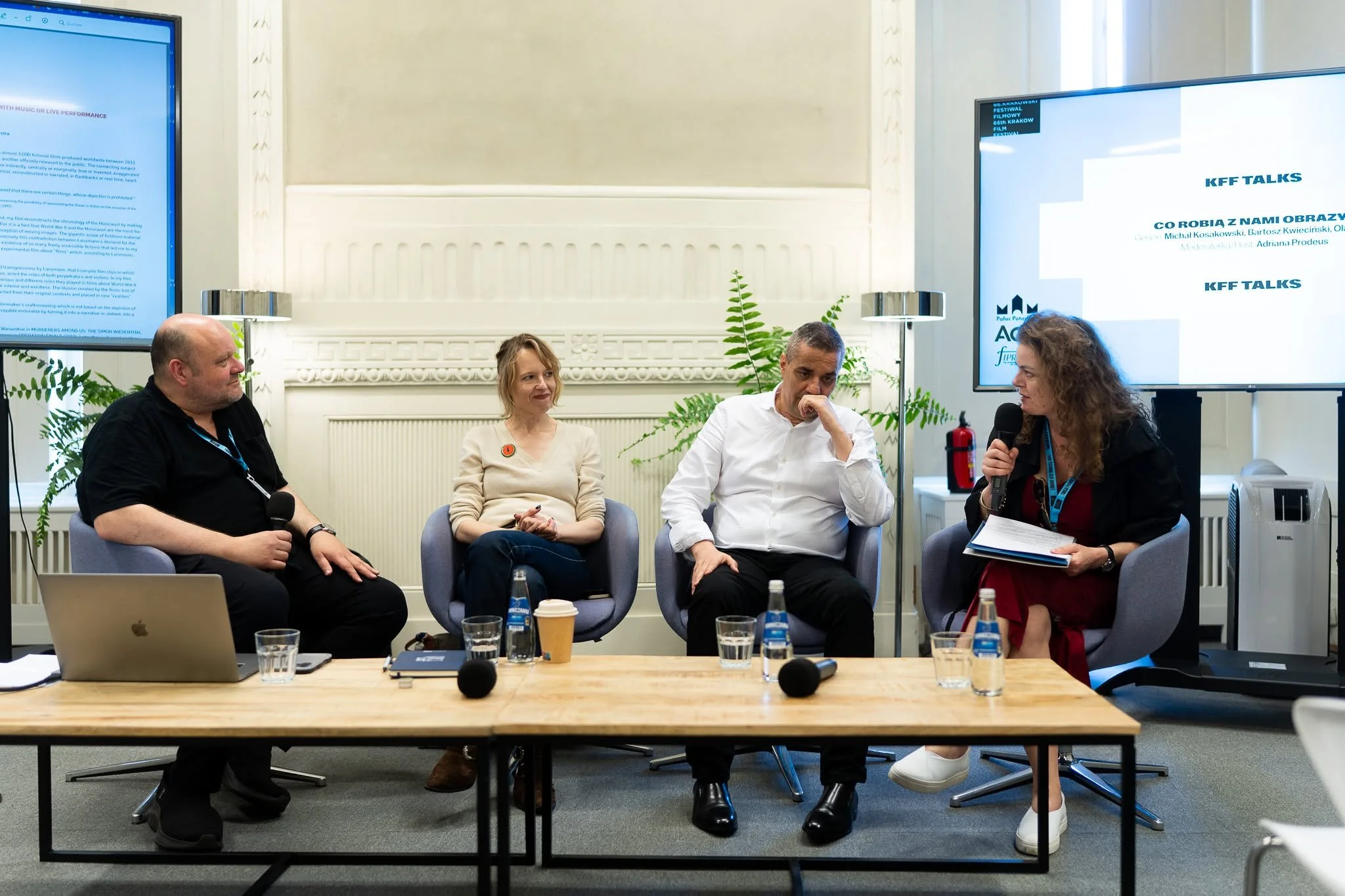
From left to right: Ola Salwa, Dr. Bartosz Kwieciński, Anita Piotrowska • Photo © M. Zygmunt
In Tel Aviv, I had been the outsider, looking at an Israeli trauma from a different cultural perspective. In Krakow, I was perceived not only as a filmmaker from Berlin, but also as a Pole.
I had the impression that my own perspective had itself become part of the discussion. Who is this director? Which images does he know? Which traditions does he draw upon? What responsibility does he assume when dealing with a subject so deeply intertwined with Polish history, memory, and national identity?
Precisely because HOLOFICTION includes so many Polish films, the discussion in Krakow acquired a particular depth. It was no longer only about a general visual history of the Holocaust, but also about Polish cinema – its motifs, its traditions, and its own forms of remembrance.
Post-war Polish film history played a particularly important role. The name of Wanda Jakubowska and her 1948 film OSTATNI ETAP (THE LAST STAGE) came up repeatedly – one of the earliest feature films about Auschwitz, directed by a filmmaker who had herself survived the camp. Dr Bartosz Kwieciński contributed his research on early Polish Holocaust films and their visual traditions to the discussion, revealing the precision with which particular motifs, compositions, and historical references are analyzed.
It was in Krakow that I became especially aware of how strongly national film cultures create their own visual cultures of remembrance. The images we recognize today as typical Holocaust imagery originate neither from a single film nor from a single country. They are the result of an international visual dialogue that has unfolded over decades. Polish, German, American, French, Italian, and Soviet films have collectively created a visual canon that continues to shape our imagination of the Holocaust.
And yet every culture reads these images differently.
How sensitive the relationship to images remains in Poland became evident even before the discussion itself began. The Krakow Film Festival had used a short sequence from HOLOFICTION in one of its promotional trailers. The clip shows Eva Braun holding a film camera. In reality, however, the image is not historical footage but comes from the television drama SPEER UND ER (SPEER & HITLER: THE DEVIL’S ARCHITECT). Removed from its original context, the image appeared to stand on its own. Many viewers had no idea where it came from. It quickly became the subject of a public debate over why this particular image had been chosen for the trailer.
I found that moment particularly revealing. Because suddenly, the very question from which HOLOFICTION begins had entered the discussion itself.
An image appears. It has an effect. It provokes reactions. Yet almost nobody first asks: Where does this image actually come from? Is it a document? A staged reconstruction? A historical fragment? Or a shot from a feature film? What did it originally mean, and what meaning does it acquire once it appears in a different context?
The debate surrounding the festival trailer thus became part of the very question the film itself poses.
Anita Piotrowska referred to the incident at the very beginning of the discussion. Suddenly, we were no longer speaking in abstract terms about the power of images. We were discussing an image that had only just demonstrated that power. An image of Eva Braun holding a camera. An image from a feature film. An image that had acquired a different meaning simply by being placed in a new context.
The viewers did not respond to the historical Eva Braun. They responded to her cinematic representation. An image of an image. An image that had lost its origin. It is precisely such shifts between origin, context, and meaning that fascinate me.
HOLOFICTION does not seek to create a new representation of the Holocaust. Instead, it uncovers the representations that already exist. The film traces how images circulate, how they are repeated, how they become iconic, and how they eventually become part of our cultural memory. My concern in Krakow was therefore less to defend individual representations than to reveal their origins and the ways in which they continue to shape perception.
In Tel Aviv, the film was read through personal experience. In Krakow, it was read through the lens of film history. The same shots, the same motifs, the same gestures opened up a different space of remembrance.
What do images do to us?
They shape expectations. They create recognition. They structure memory. And sometimes they influence our perception of reality more profoundly than reality itself.
As I left the Potocki Palace, I had the feeling that my own understanding of HOLOFICTION had shifted once again.
The film itself had not changed.
But the questions it invited had.
TORONTO: WHO OWNS MEMORY?
The third panel discussion took place on 13 June 2026 at the Toronto Jewish Film Festival under the title Shared Memory: The Holocaust in Popular Art.
On the panel, I was joined by Israeli cartoonist Michel Kichka, author of the graphic novel Second Generation: The Things I Didn't Tell My Father, and Canadian writer Bernice Eisenstein, whose book I Was a Child of Holocaust Survivors is considered one of the most important autobiographical accounts of growing up as part of the second generation. The discussion was moderated by Assaf Gamzou of the Israeli Cartoon Museum.
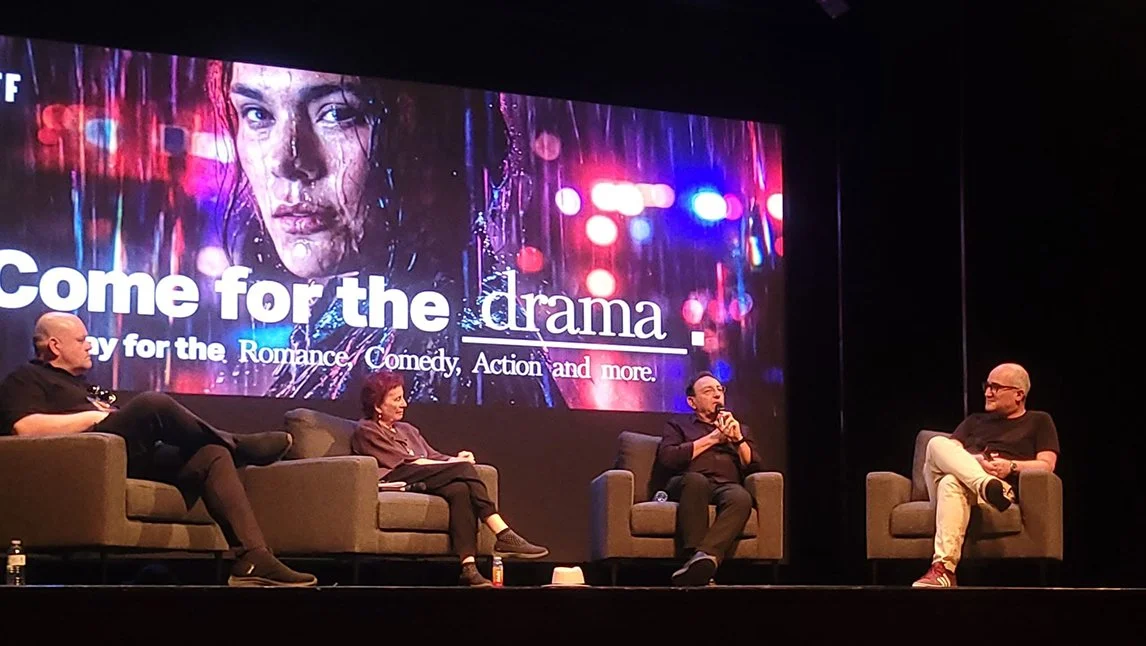
From left to right: Michal Kosakowski, Bernice Eisenstein, Michel Kichka, Assaf Gamzou • Photo © TJFF
Within the first few minutes, it became clear that this conversation would unfold very differently from those in Tel Aviv and Krakow.
Whereas Tel Aviv was shaped by the presence of the present, and Krakow by the history of images, Toronto revolved around the transmission of memory from one generation to the next. The people on the panel were not survivors themselves. They were individuals who had grown up with the memories of those who had survived.
Only later did Helen Zuckermann, founder and Artistic Director of the Toronto Jewish Film Festival, tell me that Toronto is home to one of the largest communities of Holocaust survivors and their descendants in the world. Perhaps this also explains the particular intensity with which memory is discussed there.
Very early in the conversation, Bernice Eisenstein voiced a clear criticism of HOLOFICTION. She described her experience of the film as a form of emotional numbing. For her, the individual stories, destinies, and characters of the original feature films possessed greater emotional force than the montage I had created from them. She argued that while the original films moved her deeply, the collage diminished that emotional impact.
I did not experience this as a personal attack, but rather as the expression of a fundamental difference in perspective.
For the first time, I realized that HOLOFICTION might not simply provoke different reactions; it might also touch upon fundamentally different ideas of what memory itself is meant to be.
For someone like Bernice Eisenstein, memory is inseparable from family experience. History is not something to be researched; it is part of one's own biography. The stories of parents, the traumas of a family, and the images of the past become elements of personal identity.
My own approach is different.
I am neither a survivor nor the descendant of survivors. I am a filmmaker from Poland who is interested in the history of images. What concerns me is not only what is remembered, but how memory itself is shaped.
Rather than responding with a counterargument, I began to speak about my own journey. About the eight years I spent researching HOLOFICTION. About watching more than three thousand feature films. About the discoveries I made during that process. About the visual patterns that recur across decades of cinema. And about the questions that gradually emerged from them.
I did not make HOLOFICTION to replace existing memories. I made it because I wanted to understand why we imagine certain historical events in the particular ways that we do.
As the discussion unfolded, it became increasingly clear to me that two different concepts of memory were meeting each other. On one side stood memory as personal and familial experience; on the other, memory as a cultural system of images. These two perspectives do not contradict one another. Yet they inevitably lead to different ways of understanding the past.
Perhaps this also has something to do with my own biography. As a Pole who grew up in Austria, worked in Italy, and has lived in Germany for many years, I move between different cultural spaces. For that reason, I find myself less interested in national or familial narratives than in the structures that underlie them.
This perspective also informs projects such as HOLOFICTION and the larger DARK TOURISM cycle. Ultimately, my work is not only about the past. It is about the future of memory.
How will future generations perceive the Holocaust once the last eyewitnesses are gone? What role will films, television series, video games, comics, social media, or artificial intelligence play in that process? How do cultures of remembrance change when images become more influential than lived experience?
These are the questions at the center of my work.
While Michel Kichka and Bernice Eisenstein spoke about their personal and familial relationships to memory, I realized that my own role on the panel was somewhat different. I found myself speaking less about memories than about systems of memory; less about individual stories than about the images from which those stories are constructed in our collective imagination.
Perhaps that was the real tension of the discussion. Not the question of who was right, but from which position each of us was looking at the same past.
In Tel Aviv, I found myself among eyewitnesses. In Krakow, among film historians. In Toronto, among the heirs of memory. Once again, the discussion revolved around the same images. Yet once again, they told a different story.
Only after the event did I find myself thinking back to a conversation that my partner and producer, Uli Aigner, and I had had with Bernice Eisenstein the evening before.
She told me that what unsettled her was not only the images themselves, but also the way HOLOFICTION had come into being: the years spent watching more than three thousand feature films, collecting, archiving, cataloguing, and organizing thousands of image fragments in an attempt to reveal an underlying system.
To her, this act of ordering possessed something deeply disturbing. She suggested that the precision of this method reminded her of the bureaucratic and organizational structures through which the Nazis had planned and administered the Holocaust.
It was probably the most challenging criticism I encountered during the entire festival journey. And yet, I found it profoundly illuminating. It revealed how differently the same working process can be perceived.
For me, collecting and organizing images is an archaeological practice – a way of uncovering visual patterns that had accumulated across decades of cinema, an attempt to understand the history of images themselves. For Bernice Eisenstein, the very same process is connected to an entirely different historical and emotional experience.
Perhaps this is where the difference between our perspectives truly lies. I approach images as cultural artefacts that can be examined. She encounters them as part of a living family memory. What is analysis for me may already feel like distance to someone else. What is understanding for me may feel like the loss of intimacy for another.
That is why her remark stayed with me for so long. Not because I agreed with it. But because it articulated a question that reaches far beyond HOLOFICTION:
Can memory be examined without wounding it?
Perhaps there is no definitive answer.
Michal Kosakowski
Berlin, June/July 2026